2026 Prize Laureate
Dr. Tomer Malchi
CultivAid, CEO
“If we have the ability to help others, we have the responsibility to deliver.” said Dr. Malchi. “This honor validates CultivAid’s decade of work and empowers us to expand our model and unlock economic opportunity and sustainable food security for millions of people.”
Dr. Tomer Malchi is the Co-Founder and CEO of CultivAid, an international nonprofit organization advancing agricultural innovation, climate resilience, and economic development across East Africa and the MENA region. He holds a PhD from the Faculty of Agriculture, Food and Environment at the Hebrew University of Jerusalem, where he also completed his bachelor’s and master’s degrees, and an bachelor’s degree in Industrial Labor Relations from Cornell University
Since the age of 18, Tomer has been engaged in a wide spectrum of volunteerism, activism, and international development work, ranging from community and workplace organizing to environmental advocacy and global agricultural development. Born in Israel and raised near New York City, his perspective is shaped by a strong personal connection to both developed and developing contexts, and by a commitment to pragmatic, data-driven solutions for global challenges.
At the age of 26, Tomer returned to Israel with the goal of addressing critical international challenges related to agriculture, water, and nutrition, the three core sectors that continue to define his professional focus. In 2016, he founded CultivAid as an outcome of an agricultural development program he led through Engineers Without Borders Israel, with the aim of building long-term, knowledge-based infrastructure rather than short-term interventions.
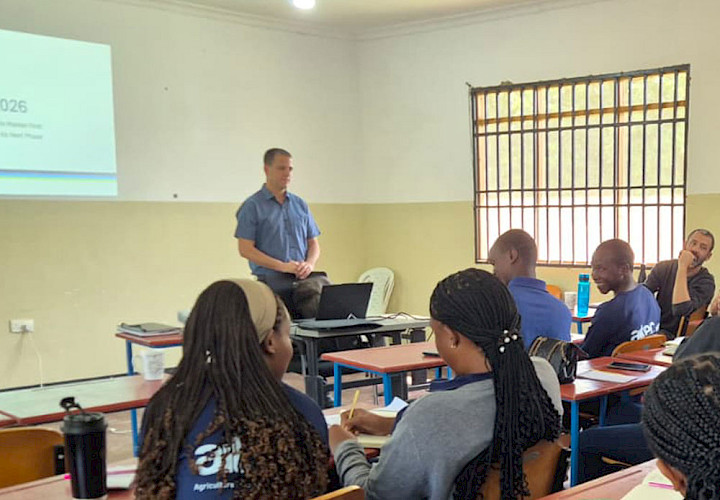
Tomer is the co-architect of CultivAid’s Agri-Helix approach, which integrates research and development, farmer production, and market-driven value chains into a unified, self-sustaining framework. Under his leadership, CultivAid has established Agricultural Innovation and Technology Centers (AITECs) in Ethiopia, Tanzania, and Kenya, with expansion underway in Zambia. These hubs function as living laboratories that combine hands-on training, capacity building, and technology transfer, while developing local experts and strengthening institutional ecosystems.
Tomer’s work is grounded in the belief that sustainable development is built through systems, not projects. He emphasizes personal responsibility, market integration, and durable infrastructure as the foundations of long-term impact. Rejecting one-off solutions, he focuses on building local knowledge ecosystems that can adapt, scale, and sustain themselves over time. Through disciplined execution, data-driven decision-making, and cross-sector collaboration, Tomer works to translate innovation into measurable outcomes that strengthen food systems, livelihoods, and resilience in vulnerable regions.